

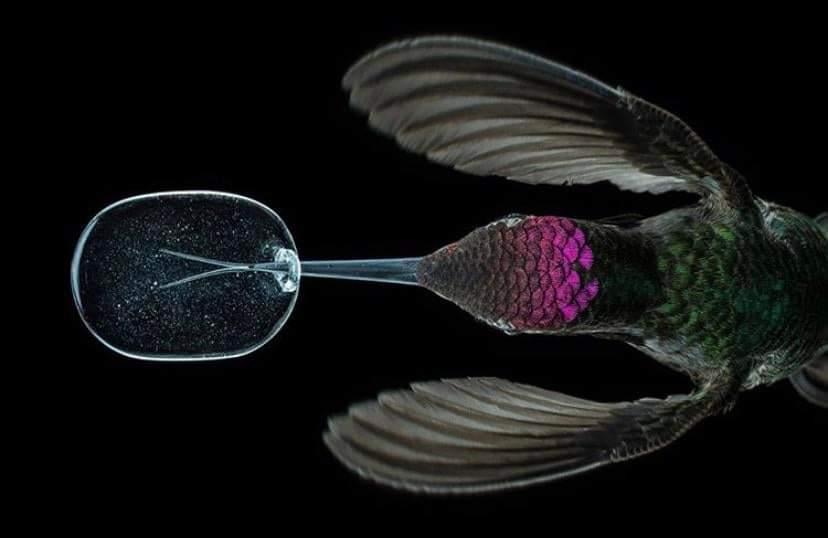
Our journey began with a clear goal: propulsion offering greater agility, better use of energy and less noise. Observing God’s creation continually inspired our questions. Blessed is God, the best of creators. The hummingbird gave us a compelling scene to contemplate: a small creature holding its position in the air and changing its movement precisely
Each wingbeat moves air and leaves a wake of motion and vortices. That wake persists for a time, so the next wing movement encounters air with an existing state. “Air memory” is our simple description of that persistence
Studies of hummingbird airflow reveal vortex structures associated with wing motion. A simulation of a ruby-throated hummingbird found that wing–wake interaction can enhance lift during parts of the stroke, while other effects can offset that benefit. Its effect therefore depends on timing, wing trajectory and the state of the air
For us, this opened an engineering question: how can we receive moving air and coordinate our interaction with it? Air reaching a new stage carries direction, momentum and effects created by the preceding movement. Understanding what arrives, and when, becomes the basis for deciding how to interact with it
A skilled table-tennis player offers a useful analogy: the incoming ball already has speed, direction and spin. The player coordinates racket position, timing, angle and added force. This illustrates receiving and redirecting motion; airflow has a distributed, complex behaviour that requires calculation and experiment
From this question grew our Air Reactor vision: stages interacting with the incoming air state and reorganising momentum as it moves through the unit. Electrical energy powers the process, and testing establishes which objectives have been achieved
This is the role of inspiration in the HPS journey. Research describes bird behaviour under the conditions studied; our engineering concept is evaluated through calculation, simulation, prototypes and measurement. We continue that work across development generations, towards the integrated unit now in development
Sources and further reading
This content was reviewed and approved for publication by HPS Aviation. Detailed test data is available to qualified investors and partners under NDA
More from this author
 Can the Roadster go further?
 Cycloidal propulsion: the foundation we built on
Article discussion
Start the discussion with a question or an idea.
Sign in to commentReport an abusive comment