
What fascinates me as an engineer is that we are still discovering the mathematical limits of the very equations we use every day to design aircraft and engines, often with excellent practical results.
Despite the progress of aviation, fundamental questions about fluid motion continue to demand deep mathematical research. That makes recent advances in AI-assisted scientific discovery particularly interesting to those of us developing new aviation technology
The Navier–Stokes problem
The Navier–Stokes equations have their roots in the nineteenth-century work of Claude Navier and George Stokes. They describe fluid motion and underpin models used in aircraft, engine and turbine design, as well as ocean and weather studies.
One mathematical question is whether solutions of the three-dimensional viscous equations for an incompressible fluid remain smooth over time, or whether that smoothness can break down. One possible form of breakdown is a velocity that becomes mathematically unbounded in finite time, despite regular initial conditions.
The existence and smoothness question became one of the seven Millennium Prize Problems announced by the Clay Mathematics Institute in 2000, with a one-million-dollar prize attached to each problem
AI enters an era of scientific discovery
On 8 September 2026, OpenAI announced that an internal AI system had produced a proof addressing the Navier–Stokes problem. It released a mathematical paper and a formalisation in Lean.
The result concerns a three-dimensional viscous incompressible fluid. Under a smooth external force, motion can begin from rest and develop unbounded velocity in finite time while kinetic energy stays bounded. This describes the behaviour of a mathematical model, not a real fluid moving infinitely fast. External forcing is part of the result, so it should not automatically be extended to the unforced case.
In its statement of 11 September 2026, the Clay Mathematics Institute welcomed the announced result while emphasising its deliberately unhurried process for evaluation and attribution. Announcing a proof and completing the formal prize evaluation remain distinct steps.
For me, this raises a broader research question: how can we benefit from systems capable of helping explore new scientific paths while keeping verification and review at the centre of the process?
The Air Reactor and its aerodynamic challenges
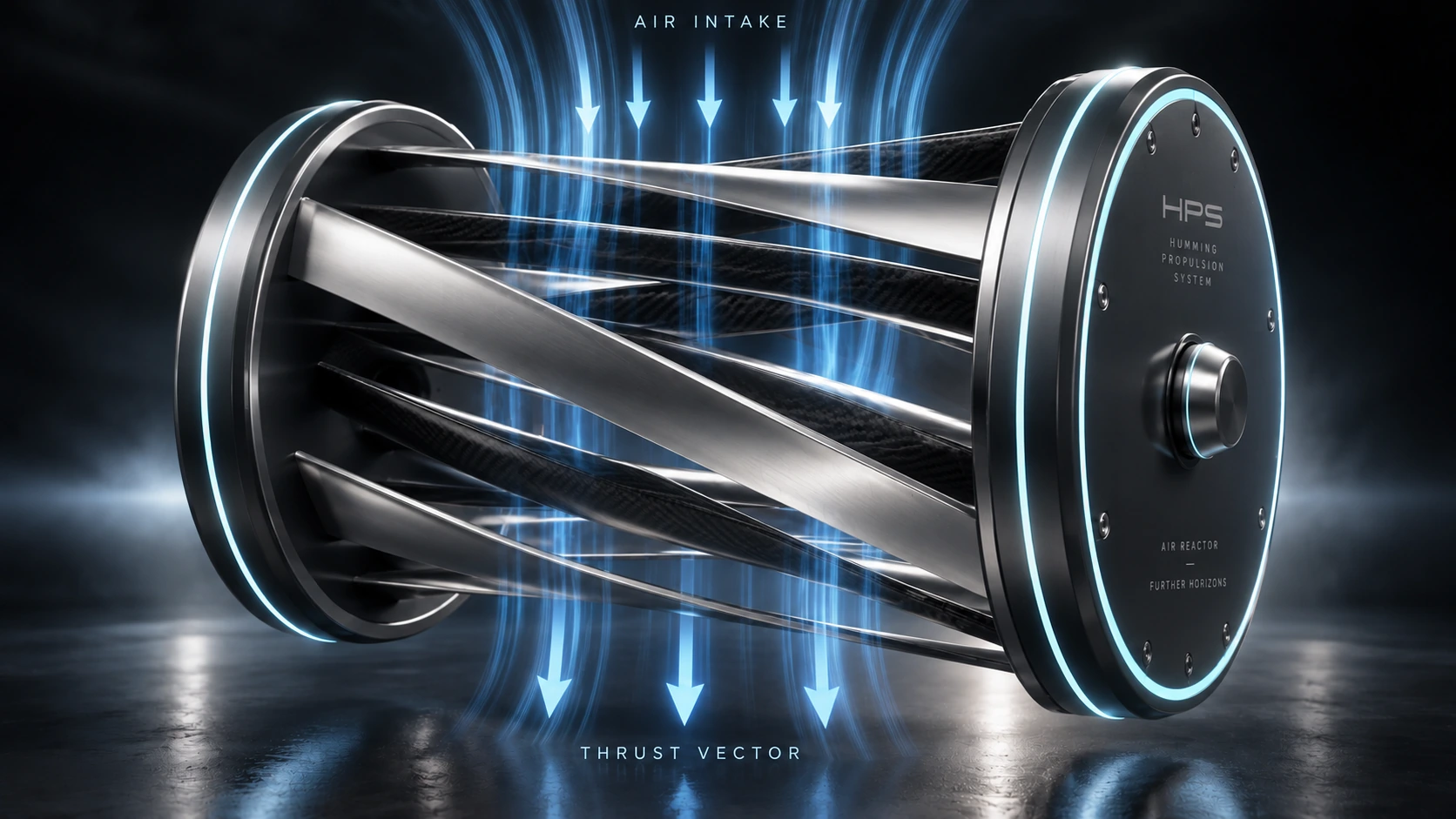
At HPS Aviation, our development journey spans more than a decade of work on the Humming Propulsion System, built around the Air Reactor concept. We are developing TANNANA aircraft around this technology to demonstrate its practical value in advanced aerial vehicles.
The concept manages airflow and interactions between stages, using rotating blades with variable angles of attack to generate and direct thrust. This architecture presents demanding engineering challenges, including:
- Dynamic interactions between counterrotating blade groups.
- The formation of vortices and their interaction between stages.
- Rapid changes in angle of attack and the associated loads.
- Controlling flow separation from blade surfaces.
- Improving the conversion of energy into useful thrust.
- Reducing noise and vibration.
Throughout development, computational fluid dynamics (CFD) and physical experiments have been essential tools for understanding these phenomena and improving successive generations. Simulation helps us explain behaviour; measurement tests how closely that explanation matches the system itself
What could advances in AI mean for HPS?
The new mathematical proof does not itself provide a ready-made Air Reactor design model or validate its performance. What interests us is the growing ability of AI to support research and analysis. We see several possible directions worth investigating and validating:
Faster engineering simulation
Supporting models could learn from reliable simulations and experiments to estimate selected flow properties quickly. They may help screen design options before detailed simulation is assigned to the most relevant cases, provided their accuracy and limits are established.
Design optimisation
AI could help explore blade shapes, stage arrangements and motion timing against thrust, power and load requirements. A proposed configuration becomes useful when it survives analysis and testing under the actual constraints of the system.
Control-system development
We could investigate strategies for responding to changing operating conditions and controlling blade angles and thrust direction. Any proposed strategy would need stability, response and operating-limit tests before flight use could be considered.
Experimental data analysis
Identifying relationships between thrust, power, vibration and operating conditions, then comparing them with simulation, may help locate discrepancies and focus the next experiment on a more precise question.
Exploring new hypotheses
AI could help the team propose explanations and configurations beyond the initial design options. These remain hypotheses until tested, but a wider search may uncover opportunities that conventional workflows would miss
A practical example: from blade timing to the test rig
One application worth exploring is the timing of blade-angle changes during each rotation and their relationship with airflow arriving from the preceding stage. A supporting model could suggest a small number of promising configurations for more detailed simulation and rig testing under comparable conditions.
We would then measure thrust, power consumption, loads and vibration to establish whether the predicted improvement actually occurred. This is an example of a possible research workflow, not an announcement of an AI system already deployed at HPS or of performance results already achieved.
Data quality, an appropriate physical model, engineering validation and safety requirements remain essential at every step
The future of research and development
For deep-tech companies, moving from a scientific idea to a practical product requires substantial time and funding. AI may allow small engineering teams to investigate more alternatives, analyse more data and direct resources towards the most informative experiments.
At HPS Aviation, we see this as an opportunity to improve the research process itself: clearer questions, design decisions supported by better evidence, and faster learning from each experiment.
For me, the real value will come when these tools help us reach a design we can explain and a result we can measure and reproduce on the test rig. That is how progress in research tools can become progress we can build on in developing the Air Reactor and TANNANA aircraft
Sources and further reading
This content was reviewed and approved for publication by HPS Aviation. Detailed test data is available to qualified investors and partners under NDA
More from this author
 Can the Roadster go further?
 Humming Propulsion: From Cyclorotor to Air Reactor
Article discussion
Start the discussion with a question or an idea.
Sign in to commentReport an abusive comment